
High Mileage Leases – Buy Additional Miles
What are the pros and cons of buying extra miles for a car lease?
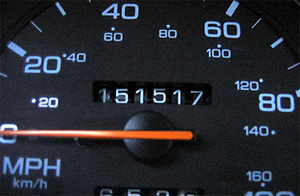 Many people would like to lease but know that they will exceed the standard mileage limit, which is usually 12,000 miles per year. They know they need a high-mileage lease but don’t want to pay the end-of-lease penalties.
If that is the case, does leasing make sense? If so, how do extended mileage leases work? What will it cost extra? Is there a downside to doing it ?
What is an extra mileage car lease?
Let’s say you know you will drive about 20,000 miles per year and you would like to lease your next car. Since the cost of leasing is based on the difference between a car’s initial cost and it’s lease-end residual (market resale) value, the larger that difference, the higher the cost. If the car is only driven 15,000 or 20,000 miles a year, most cars will still have good value at the end of a typical three year lease — usually about 40%-50% of original value.
Now, lets, assume an extreme case in which a car is driven 70,000 miles a year. After three years, the car will have 210,000 miles on it — and have very little remaining value. The car will have been essentially “used up” and worn out. If you leased that car, your lease cost would be about the same or more than if you had purchased the car because your lease is paying for almost the entire cost of the car. Leasing makes absolutely no sense in that case. It saves you no money over purchasing.
Therefore, leasing begins to make less and less sense as you exceed the normal 12,000 mile-per-year average. Since cars begin to lose most of their value at around the 100,000 mile mark, leasing is practical only when the total mileage limit for the term of the lease doesn’t exceed that number. So, for a three-year lease, 30,000 miles a year is about the practical limit.
What do the extra miles cost?
Extra miles on a leased car decreases its lease-end residual value — because more of the car’s value has been “used up.” When calculating the cost of an extended mileage lease, dealers subtract that extra depreciated value from the normal 12,000 mile residual value, which raises the monthly payment.
Let’s look at an example. Say a car has a normal lease-end residual value of $15,000 after three years, based on a normal 12,000 miles per year. But a customer wants 20,000 miles per year, which is 24,000 total additional miles over three years. Let’s see how it increases the cost of the lease.
The cost of each extra mile is set by the lease company and will range from $0.10 to $0.25 per mile, depending on the vehicle and the lease company.
Let’s assume the rate is $0.15 for our example. This means the total cost of those extra miles is $0.15 x 24,000 = $3600. The new residual value on which the lease is calculated is now $15,000 – $3600 = $11,400. Since the residual value is now reduced, the monthly lease payment will be higher and the total cost of the lease is higher.
Can I buy extra miles in the middle of a lease if I see I’m going over my allowance?
No. You cannot buy extra lease miles during a lease, only at the beginning. If you are already in a lease and see that you are already exceeding your allowance, there are a number of options. See our article, Over Mileage Car Lease for more details.
How to evaluate an extra-miles lease deal. Is it a good deal or not?
You may have noticed that our lease deal evaluation tools such as the Lease Evaluator in our Lease Kit only go to 15,000 miles and can’t be used to directly evaluate a higher mileage lease.
However, the proper way to evaluate such a lease is to get your dealer to first give you the numbers and monthly payment for a normal 12,000 or 15,000 miles lease. This is the “base” lease deal and can be easily evaluated with our tools. The value of this base lease deal will not change by the addition of extra miles into the lease. For example, if the 12,000 mile base lease deal is rated EXCELLENT, a 20,000 mile deal is also EXCELLENT — assuming you don’t grossly overpay for each of the extra miles, which is highly unlikely. Buying extra miles in a lease increases the monthly payment, but doesn’t affect the value of the overall deal.
What are the advantages of buying extra lease miles
The advantages of buying extra miles up front are:
- Per-mile cost is usually lower than paying at lease-end
- You pay for the miles as you go, with each monthly payment, or
- You have the option of paying for the miles in cash as part your down payment
- Most lease companies will refund you for any unused miles (of the extra purchased miles)
What are the disadvantages of a high-mileage car lease?
Other than the additional cost created by extra miles, there are some other things to consider.
First, lease companies do not change their wear-and-tear policies for extended mileage leases. Driving a car 20,000 miles a year is almost certainly going to create more wear-and-tear and opportunity for dents and scrapes than with a 10,000 mile-a-year lease. Lease companies expect the car to be returned in the same condition either way. If the extra wear and damage is not fixed prior to the car’s return, the lessee will be charged for it.
Next, let’s discuss the subject of warranties.
Normally, we advise people to lease for a term that is no longer than the the general-coverage manufacturer’s warranty, which is typically 3 years, although some are 4 and 5 years. But that advice is based on the way manufacturers specify warranties. For example, a 3 year warranty is usually stated as “3 years OR 36,000 miles” which means 12,000 miles a year. Even a conventional 15,000 miles-a-year lease will exceed the 36,000 mile warranty — and an extended mileage lease will exceed it even more.
A leasing customer with a high mileage lease will be exposed to having to pay for repairs out of his own pocket – for a car he doesn’t own – after the manufacturer’s warranty expires. This might not be a great risk for car brands such as Honda or Toyota that have a history of being very reliable, but any vehicle is more likely to fail as it gets older and accumulates more miles.
What’s the answer to the warranty issue?
The answer is to purchase an extended warranty to cover the entire term and mileage of an extra miles lease.
Dealers typically offer extended warranties at the time of purchase or lease. However, they are expensive and offer little or no benefit during the first years of a lease when the manufacturer is already providing free warranty coverage.
It makes more sense to get an extended warranty from an independent, but reputable, company that offers not only coverage for the time after the manufacturer’s warranty expires, but offers additional coverage during the manufacturer’s warranty period. You can wait to buy the warranty a couple of months before the manufacturer’s warranty expires, although you might find that it’s cheaper to buy earlier.
We suggest Warranty Direct® and Endurance Vehicle Protection
, as reputable companies for extended warranties. Be sure to check out their web sites and consider their service if you plan on a high-mileage car lease. Get free price quotes from both services to compare.
What if you decide leasing is not the right answer?
Then you’ll want to purchase your vehicle. However, since you’ll be driving lots of miles, the discussion above regarding extended warranties is just as important, if not more so. By driving so many miles, your manufacturer’s warranty will expire sooner than normal and you’ll be left without protection. An extended warranty is the answer. Again, don’t buy a dealer’s warranty as the cost is mostly his profit. Buy from a reputable independent provider and save money.